City expects to remove dead Douglas firs
By Damian Mann for Ashland.news
A massive Douglas fir die-off in Ashland’s watershed will require helicopter logging this winter to reduce the chance of a catastrophic wildfire.
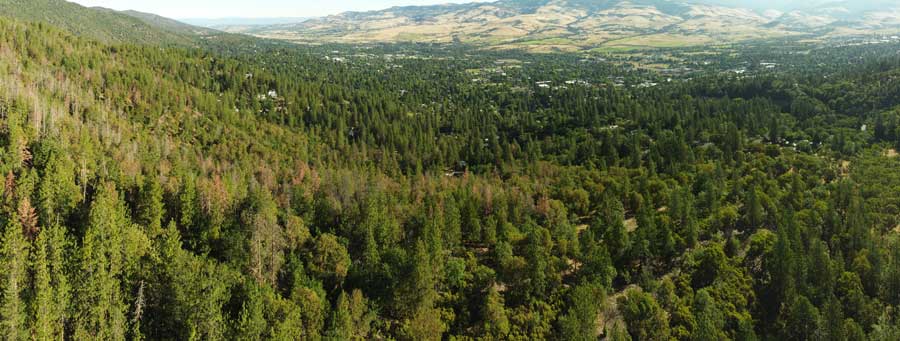
The city is currently waiting for a report on the recent drone mapping of the forests to determine the extent of the damage, clearly visible from the streets of Ashland as large reddish patches in the forest.
“It’s really surprising everybody,” said Chris Chambers, division chief for Ashland Fire and Rescue.
The city will try to salvage as much of the timber as possible to help offset the expense of using helicopters on steep hillsides.
Getting the trees early before the bugs and fungus attack them increases their value to mills and reduces the cost of the thinning project.
The city’s approach isn’t universally applauded by some scientists and environmentalists.
“They think hands-off is the best approach,” Chambers said. “But we need to stay on top of this issue by dealing with fuel accumulations.”
Chambers said a majority of studies of thinning and selective logging supports the approach Ashland is taking.
Some local landowners who have experienced Douglas fir die-off are also working with a local forester to log their properties in the woodland interface with the city.
Preserving the watershed is critical to the city, which relies on the forests not only to maintain its main water source and provide recreational benefits to residents, but also to reduce the chances of a potential cataclysmic fire that could overrun the city.
On Thursday, Ashland residents had a scare when a 2-acre fire erupted, but was quickly extinguished near Reeder Reservoir, the source of the city’s water.
Chambers said it is too soon to tell if the latest die-off is worse than another die-off that occurred in 2001-2003.
He said the analysis of the drone footage should provide better data on what percentage of the forest has been compromised by a prolonged drought, hotter summers, warmer winters as well as beetle and fungus infestations. These changing conditions are expected to worsen over time because of climate change.
“We need to do what we can for as long as we can to maintain the forests,” he said. “The truth is some of our forests are going away and it is very concerning.”
The drone footage will also provide information on whether dead trees are on public or private lands.
Chambers said local residents need to be prepared for more prescribed burns in the cooler seasons to burn off underbrush, something Native Americans did for thousands of years as a way to manage forests.
Getting rid of so-called ladder fuels, or undergrowth, in these burns is a step toward avoiding more devastating crown fires.
After a die-off in 2001-2003, the city, as part of the Ashland Forest Resiliency Project in 2004, did a similar clearing of dead or dying trees.
The salvaged timber was sold to the Boise Cascade mill in White City for $262,650, and Superior Air charged $263,091 for the helicopter that removed 9,066 logs, resulting in minimal cost to the city.
“The average tree was 10 inches in diameter,” Chambers said. “This time it will be much larger.”
If the cost to remove the trees exceeds the proceeds from the sale of the timber, Chambers said the city would seek federal grants to cover the difference.
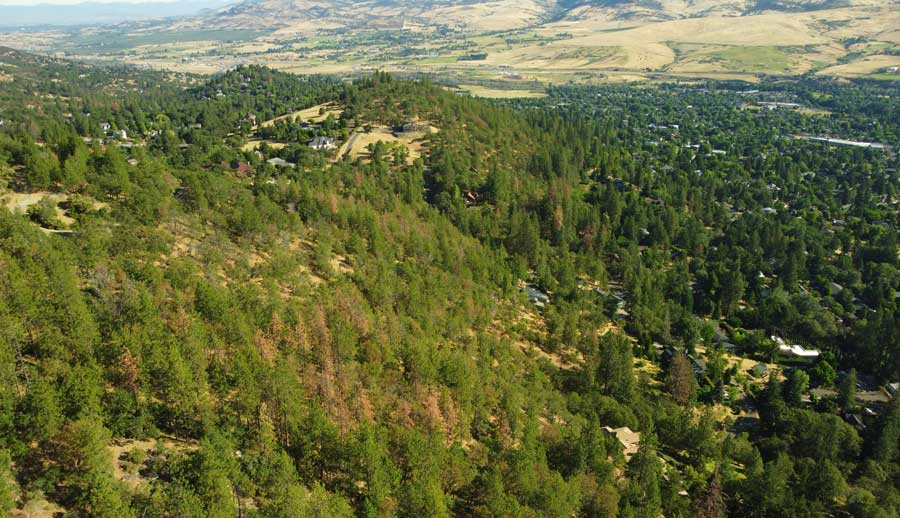
An analysis of the forests in 2020 showed some die-off, but nothing significant. Some trees along trails were removed at that time.
“It didn’t arise to the point of becoming a wildfire fuel load,” Chambers said.
Even though dead or dying trees will be removed from hillsides this fall and winter, Chambers said there will be an effort to preserve as much wildlife habitat as possible.
While he couldn’t predict what will happen to the local forests because of climate change, he said residents should be prepared for radically different forests in the coming years.
“Our objective is to hang on to as much as those species as long as possible,” he said.
A Talent resident and scientist whose house was spared during the 2020 Almeda Fire said logging to minimize wildfire risk is the wrong approach.
“It’s laughable,” said Dominick DellaSala, chief scientist with Wild Heritage, Project of Earth Island Institute. “What you’re doing in the back country will have zero impact on home ignition.”
Communities need to invest in better efforts to increase defensible space around houses, push for fire-hardened houses and develop better evacuation plans rather than the chaos on the roads witnessed during the Almeda Fire, said DellaSala, who has written 150 technical papers on temperate and boreal forests as well as analyses of ecosystems in the U.S. and Canada.
The Almeda Fire destroyed some 2,500 residences from Ashland to the border of Medford, primarily affecting Talent and Phoenix. If the winds had been blowing in the other direction, the fire could have potentially swept through Ashland, DellaSala said. The fire started near the dog park in Ashland.
DellaSala said study after study has shown that the big problem is that logging, along with climate change factors, actually leads to higher intensity fires in woodland areas.
He said the dead Douglas firs, once they lose their needles, shouldn’t be considered a significant fire danger or pose a significant crown-fire threat, DellaSala said.
Private landowners, on the other hand, are a bigger danger, he said.
DellaSala pointed to the Cascade-Siskiyou National Monument, a checkerboard of public and private lands.
On private lands they have three-story high slash piles,” he said. “These slash piles are really bad news.”
DellaSala said study after study has shown logged areas burn more intensely.
DellaSala said efforts to manage the forests will become increasingly unsustainable over time as climate change reaches a tipping point.
“It makes for good optics, that they’re doing something,” he said. “I’ve told them, you guys are wasting your time in the back country.”
He also cites the “exurban” sprawl that has shot up since the 1980s, putting more and more homes in the woodland interface with cities.
“We’ve made this mess along with out-of-control emissions,” DellaSaa said. “Helicopter logging isn’t getting us out of this.”
Reach writer Damian Mann at dmannnews@gmail.com.