Try this interactive explanation (have a sheet of paper handy)
By Herbert Rothschild
Last week I tried to defend Shakespeare from the now-fashionable slander that he was a fraud, passing off as his own some 36 plays written by someone who wished to keep his authorship secret. My rhetorical point of departure was the First Folio, which was published four centuries ago this year.

The terms “folio” and “quarto” are used repeatedly in reference to the appearance of Shakespeare’s play in print, and few people have a clear understanding of what they mean. So, in this column I’m going to help you achieve it.
The terms refer to the number of pages printed on a single sheet of paper, which in turn depends on the number of times the sheet will be folded. A folio edition is made up of sheets with two pages printed side by side on both front and back of the individual sheets, which are then folded once horizontally. A quarto edition is made up of sheets with four pages printed side by side and under and over (upside down) on both front and back of the individual sheets, which are then folded twice, once in each direction.
What you’ve just read may be hard to visualize, so do this:
Take a sheet of 8.5-inch by 11-inch typing paper and lay it on your desk horizontally (landscape). Take the left edge and bring it over to the right edge and smooth it down, thus making a vertical crease. Now you have four panels measuring 8.5” in height and 5.5” in width. Imagine that each of those panels is printed as a page. The result is a folio. The name derives from folding the original sheet one time.
Now, take another sheet of 8.5-inch by 11-inch typing paper, but lay it on your desk vertically (portrait). Take the top edge and bring it over to the bottom edge and smooth it down, thus making a horizontal crease. Fold the same sheet once more, this time bringing the left edge even with the right edge, thus making a vertical crease. You thereby have doubled the number of panels you have to eight but halved their dimensions—5.5 inches in height by 4.25 inches in width. Again, imagine that each of those panels has been printed as a page. The result is a quarto. You’ll see that in order to allow the pages to turn separately, the top crease must be cut.
One can continue this process of folding, producing ever smaller pages. Books with pages of these sizes have names like “octavo” and “duodecimo.” Of course, printers always begin with sheets larger than 8.5-inch by 11-inch, although there was no one standard size in Shakespeare’s time.
A book was put together by nesting a certain number of folded sheets inside each other to produce a grouping big enough to stitch together. These groupings are called signatures. If you were to nest two sheets folded even just once (folio), you would immediately notice that you cannot print the pages consecutively on the individual sheets and gather them into the correct order. And the more sheets you nest, the farther apart grow the sequence of pages on the left and right halves of the individual sheets.
The complexity of sequence increases in editions smaller than a folio, since each side of the sheets is imprinted with pages above and below each other, not just side by side. So, signatures had to be planned out in advance, and each page assigned a letter and number to designate its place in the signature and that signature’s place in the entire volume. In older books you may have noticed those designations at the corners of the pages.
The advantage to a publisher of producing smaller editions rather than larger is the savings achieved in the cost of the paper, which in Shakespeare’s time was expensive. It was made from linen and manufactured by a laborious process. To the buyer, the advantage is portability and, presumably, reduced prices. The trade-off is the size of the printed image and thus, as the page shrinks, readability.
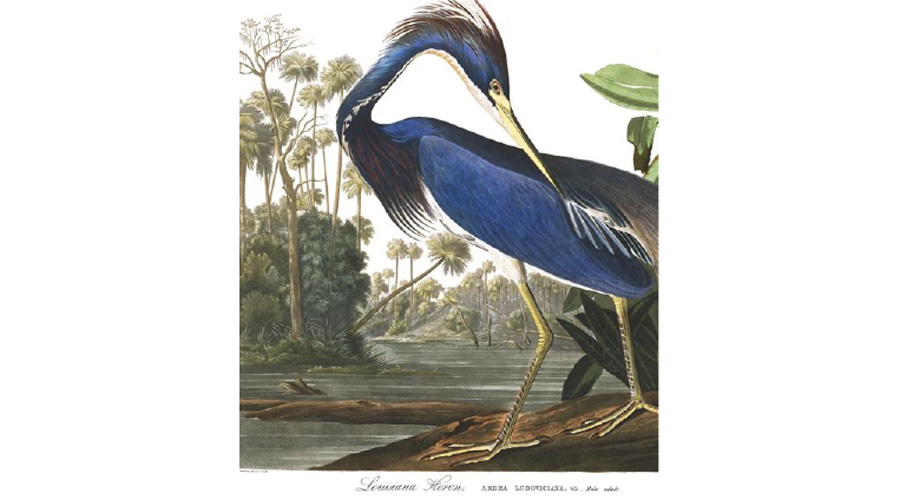
In Shakespeare’s day books were stored flat. We store books upright in both our public and private libraries, so smaller sizes work better. The larger its page size, however, the more hospitable a book is to illustration. Thus, our “coffee table” books. The most famous folio publication of an American book was John James Audubon’s “Birds of America.” Smaller pages would not have done justice to his renderings.
Herbert Rothschild is an unpaid Ashland.news board member. Opinions expressed in columns represent the author’s views and may or may not reflect those of Ashland.news. Email Rothschild at herbertrothschild6839@gmail.com.